This was achieved through new business wins as well as supporting our customers' pricing initiatives and promotional campaigns.
GROUP REVENUES
We continued to show good sales growth for the year despite tough trading conditions, with like-for-like sales growth of 5.4%.
This increase was almost entirely volume driven through successful participation in promotional activities, new product
launches and new business development. Our pricing, which excludes the one-off costs of promotion activity, remained
relatively flat as raw material inflation stabilised during Fiscal Year 2012 and price increases negotiated to offset
the effect of the inflation during 2011 remained in place. For further analysis of the Group's revenue performance refer
to our Business Review.
GROSS PROFIT
The gross profit margin for 2012 was 26.9%, representing a year-on-year increase of 90 basis points. Through a combination
of successful new product developments and effective promotional campaigns the Group has seen its gross margin return to
levels experienced prior to 2011, a year which was materially affected by unprecedented raw material inflation.
DISTRIBUTION AND OTHER ADMINISTRATIVE COSTS
Distribution and other administrative costs increased by £15.2 million, or 4.3%, as further costs were incurred to
support our investments in innovation and technical excellence to strengthen our leading competitive position.
Furthermore, additional personnel costs were incurred to deliver like-for-like sales growth; engineering costs
increased to support the final stages of capital investments; and utility costs also increased as a result of inflation.
ADJUSTED EBITDA
The adjusted EBITDA for the Group was £115.1 million, compared with £107.7 million in 2011, an increase of £7.4 million
or 6.9%. Adjusted EBITDA margin increased by 40 basis points from 6.4% in 2011 to 6.8% in 2012.
1 Adjusted EBITDA: excludes restructuring costs, management charges to the Group's parent company, asset
impairments and those additional charges or credits that are one-off in nature and significance.
RECONCILIATION TO ADJUSTED EBITDA1
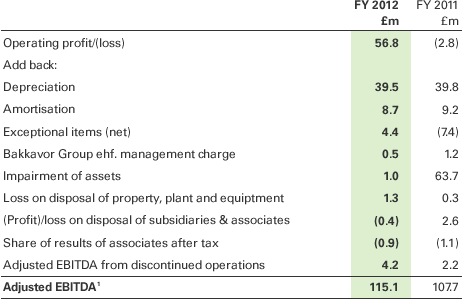
For further analysis of the Group's adjusted EBITDA performance refer to our Business Review.
EXCEPTIONAL ITEMS
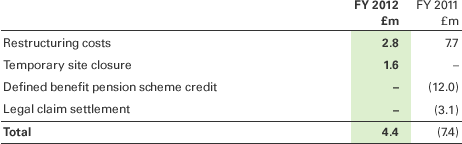
During the year, the Group incurred certain one-off costs as part of a restructuring programme to improve long-term
operating performance, particularly in Europe. The costs incurred to implement this restructuring amounted to £2.8
million in the year, the majority of which comprised redundancy costs.
The exceptional costs relating to the temporary closure at one of our manufacturing sites following a malicious and
isolated act of contamination in the year amounted to £1.6 million. This charge related primarily to the costs
associated with the disposal of products, extending our installation of CCTV cameras, and the increased costs of
working, which included additional labour costs and further security measures.
The exceptional non-cash credit of £12.0 million in 2011 related to the fall in the present value of the defined
benefit pension scheme liabilities following the closure of the Group's scheme to future accrual. Finally, the
Group received £3.1 million in 2011 following the conclusion of a legal settlement in respect of a trading dispute.
Exceptional items are those that, in management's judgement, should be disclosed by virtue of their nature or amount.
Exceptional items comprised:
IMPAIRMENT
Each year the Group is required to assess the appropriateness of its goodwill carrying value by comparing the asset
values with future cash flows expected to be generated from those assets. No impairment of goodwill or intangible
assets has been recognised in 2012, although an impairment of £1.0m was recognised in relation to tangible fixed
assets which were made redundant. In 2011, an impairment charge of £63.7 million was recognised reflecting a
write-down in the carrying values of goodwill, intangible assets and tangible fixed assets due to the combination
of adverse trading conditions and management's decision to exit certain low-margin businesses.
OPERATING PROFIT
The Company generated an operating profit of £56.8 million (2011: loss of £2.8 million). In 2011, an impairment
charge of £63.7 million was recognised but the effect of this was partially offset by a £12.0 million exceptional
credit in 2011 relating to the benefit arising from the closure to future accrual of the defined benefit pension
scheme. After stripping out the effect of these items, the Group's operating result improved by £7.9 million in
2012, reflecting the improved sales volumes and factory performance efficiencies.
NET DEBT AND INTEREST
The Group's net debt totalled £563.9 million (2011: £591.4 million), representing a reduction of £27.5 million. In line with the term loan amortisation profile, £4.9 million was repaid. An additional £19.7 million was repaid from the funds generated from the equity issue in the Group's parent company, Bakkavor Group Limited, plus proceeds from the sale of two vacant properties.
Net finance costs have reduced from £64.9 million in 2011 to £61.1 million in 2012. This decrease was due to a reduction in average indebtedness over the period coupled with certain long-term fixed rate interest swaps maturing in the year. This decrease was partially offset by refinancing costs related to the corporate re-organisation earlier in the year.
TAX
The Group recorded a tax charge of £2.8 million (2011: £2.5 million credit) as the Group became profitable in 2012.
In addition, a provision was recognised this year to cover certain tax charges that may now materialise in relation to prior years.
DISCONTINUED OPERATIONS
The Group has reached formal agreement with Agrial, Société Cooperative Agricole et Agro-alimentaire, a leading European food
co-operative, for the sale of its French and Spanish produce businesses comprising Cinquième Saison Saint-Pol SAS, Cinquième
Saison Mâcon SAS, Bakkavor France SAS, Crudi SAS and Sogesol SA for 33 million Euros debt-free cash-free.
Completion of the transaction is subject to competition authority clearance, which is expected by the end of the first half of
2013. These operations have been accounted for as discontinued operations and are therefore shown separately in the Group's
income statement.
PENSIONS
At 29 December 2012, the defined benefit surplus was £10.0 million (2011: £9.3 million surplus). There has been little
movement in this surplus as the increase in the fair value of scheme assets has been broadly offset by a broadly
equivalent increase to scheme liabilities. The defined benefit pension scheme is subject to a triennial valuation
as at March 2013.
OTHER GAINS & LOSSES
Other gains of £8.4 million (2011: gain of £6.0 million) included a £6.4 million credit arising on the change in
fair value of interest rate swaps. During the year, £250 million of interest rate swaps matured leaving £50 million
outstanding as at 29 December 2012, which matures in September 2017.
CASH FLOW
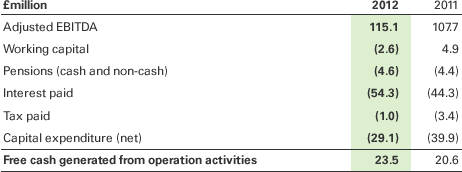
Free cash generation from operations
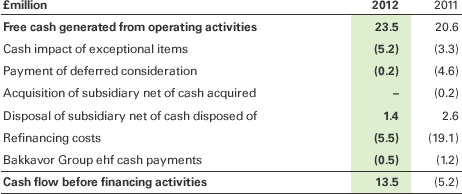
Free cash generation before financing activities
FREE CASH GENERATED FROM OPERATING ACTIVITIES
The increase in free cash generation in the year is attributable to an improved profit performance and a decrease
in capital expenditure (referred to below). Offsetting this was an increase in interest payments arising from the
payment profile attached to the Senior Secured Notes. These notes were issued in February 2011 with interest
payable semi-annually in arrears in February and August. As a result, only one interest payment was required
in the first year.
CAPITAL EXPENDITURE
Our 2011 capital expenditure programme focused on capacity enhancements across our portfolio of sites to support
our growth objectives and strengthen our market-leading positions. Whilst we have continued to invest in a broad
range of projects in 2012, our focus has been to ensure the successful integration of these prior year investments.
Nonetheless, we expect capital spend to increase in 2013. In the event of having to respond to an adverse economic
environment and manage the broader cash requirements of the business as a whole, we continue to retain flexibility
in our discretionary capital spend.