The Group Head of HR, Gillian Haythornthwaite, is responsible for ensuring employee practices and initiatives are implemented across the businesses, monitoring performance and reporting monthly to the Management Board on our employee KPIs. She manages the Group HR function which covers key employee areas such as Group recruitment, HR systems, benefits and training, and supports the UK HR business teams.
In addition, Gillian chairs the Employment Law Review Committee, which is responsible for updating Group policies, processes and procedures with revisions and changes in legislation. As part of this, Employment Law update meetings are held for business HR teams to discuss the impact of these changes and to ensure that they are communicated effectively.
In order to develop best practice across the Group and drive HR excellence, the function organises regular HR Forums and an annual HR Conference. Every two years our businesses carry out self-assessments - HR Steps to Excellence - which set out what 'good' should look like in the HR function and drive an action plan at business level for our HR teams to implement.
We have also recently appointed a Group HR Director, Pippa Greenslade, to ensure that the HR function is fully involved at a strategic level right across the Group.
EMPLOYEE RETENTION
We aim to nurture a dynamic, inclusive and values-led working environment which recognises, rewards and promotes our employees fairly to encourage them to stay with our business.
Measures and performance
Employee retention is one of our key measures and we have set ourselves a target of 90% for managers and 75% for our site-graded employees. For the fourth year in a row we have hit or exceeded our targets, achieving retention rates of 90% for managers and 92% for site-graded employees in 2012.
We also measure the number of vacancies that we fill internally and have set ourselves a target of 50%. This is an important measure as it demonstrates our wish to keep and promote good people within the business who have the right values and who understand the behaviours expected of them. This year we just fell short of our target, filling 45% of vacancies internally, largely due to our success at promoting internally the previous two years. However we will continue to focus our efforts in this area through communication and action at our Functional Forums.
EMPLOYEE DEVELOPMENT AND SUCCESSION (DAS)
The Bakkavor DAS process is focused on developing our people to reach their full potential. It includes performance appraisals, personal development plans and DAS meetings.
In 2012 we updated the DAS process, making it more relevant to our business needs across the Group and ensuring that we have the systems in place to develop and support our most talented people. This process will facilitate career development across the Group more effectively.
We have introduced a new Functional Talent Pipeline. This will help us measure the strength of each function today, as well as the potential to fill roles in the future. In addition, we also track, by individual, those employees who are ready for an immediate move as well as those ready for a move in one year. All this helps us to promote from within wherever possible.
Measures and performance
The DAS process is supported by two key measures - % of DAS discussions undertaken every six months for all employees above a certain band and % of completed annual appraisals. Our starting base in 2012 is 75% for DAS discussions and 80% for completed appraisals with a target of 100% for both.
ACCELERATED MANAGEMENT SCHEME (AMS)
We recognise the shortage of skilled and motivated people coming into the food industry and we have established our own programmes to help address this issue.
Measures and performance
Our two-year Accelerated Management Scheme is a fast-track programme for new graduates and current employees, giving them hands-on experience in 'real' jobs alongside trainers and mentors. AMS participants specialise in one of six core areas of strategic importance to the business: Manufacturing, Product Development, Technical (food safety), Produce procurement, Purchasing, and Finance. We recruited 14 people onto the Scheme in 2012 and many former AMS participants have since taken on important roles within the Group.
DIVERSITY
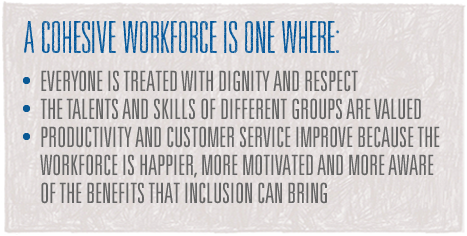
We are proud of our multi-cultural workforce and are committed to encouraging diversity within the business. In 2012 we launched a 'Better Together' self-audit tool which identifies what we need to do to make our workforce even more cohesive than it already is.
TEMPORARY LABOUR
We have seasonal requirements for additional temporary resource and, in the UK, we work closely with a selected group of fully accredited and licensed temporary labour providers, whom we audit regularly.
All UK temporary workers are subject to UK legislation and in 2012 we introduced and implemented a new system across our UK sites to promote sound governance in this area and to ensure compliance with the requirements of the Agency Workers' Directive.